
More than four centuries of Nicosia, in one building.
Büyük Hamam's story is not one of a single grand founder, but of continuous adaptation: a medieval structure absorbed into an Ottoman bathhouse, and a bathhouse never allowed to fall silent.
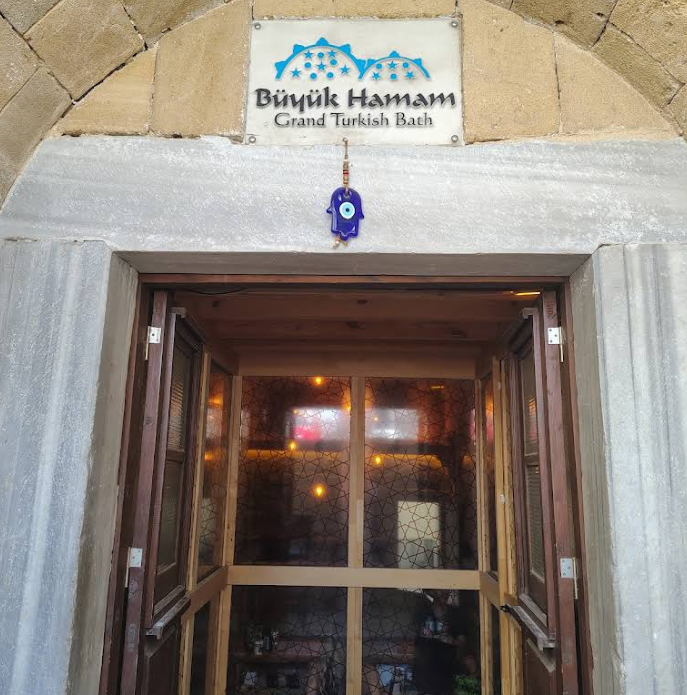
- Medieval
Architectural origins
The site incorporates elements of an earlier medieval structure. Fragments of carved stonework at the entrance point to a Gothic phase predating the Ottoman period, absorbed into the building rather than cleared away.
- 1571 – 1590
Ottoman transformation
In the decades following the Ottoman arrival on Cyprus, the building was converted into a public Turkish bath. The domes, the heated marble platform and the progression of cool, warm and hot rooms date from this period. The complex is described in the historical record as a seven-domed hammam.
- 1572
A city taking a new Ottoman form
While Büyük Hamam was becoming an Ottoman public bath, nearby Büyük Han was built as a caravanserai in 1572. No surviving evidence proves a direct operational link between them, but both belong to the same formative period of Ottoman Nicosia and remain two of the Walled City's defining monuments.
- Ottoman era onward
A social institution
For centuries the hammam served as a daily gathering place for its surrounding neighbourhood. Bathing was a household ritual, but it was also a social one — news, weddings, mourning and quiet conversation all passed through its rooms.
- Twentieth century
Architectural preservation
Successive interventions preserved the original architecture. Later work has focused on maintaining the domes, the marble surfaces and the heating that keeps the building at temperature.
- Today
Still in daily use
Büyük Hamam continues to operate as a working Turkish bath. Visitors today enter a space that has never been reduced to a museum piece — it remains part of the living fabric of Nicosia.
A note on caution.
Precise dates, patronage and architectural attribution for buildings of this period are the subject of ongoing scholarship. Where the historical record allows a confident statement, we make one; where it does not, we say so. Official North Cyprus tourism sources date Büyük Hamam's Ottoman conversion to 1571–1590 and Büyük Han to 1572. This supports their shared historical context, but not a claim of a direct relationship.